
When Monopoly Forgot Its Own Lesson: The Landlord's Game
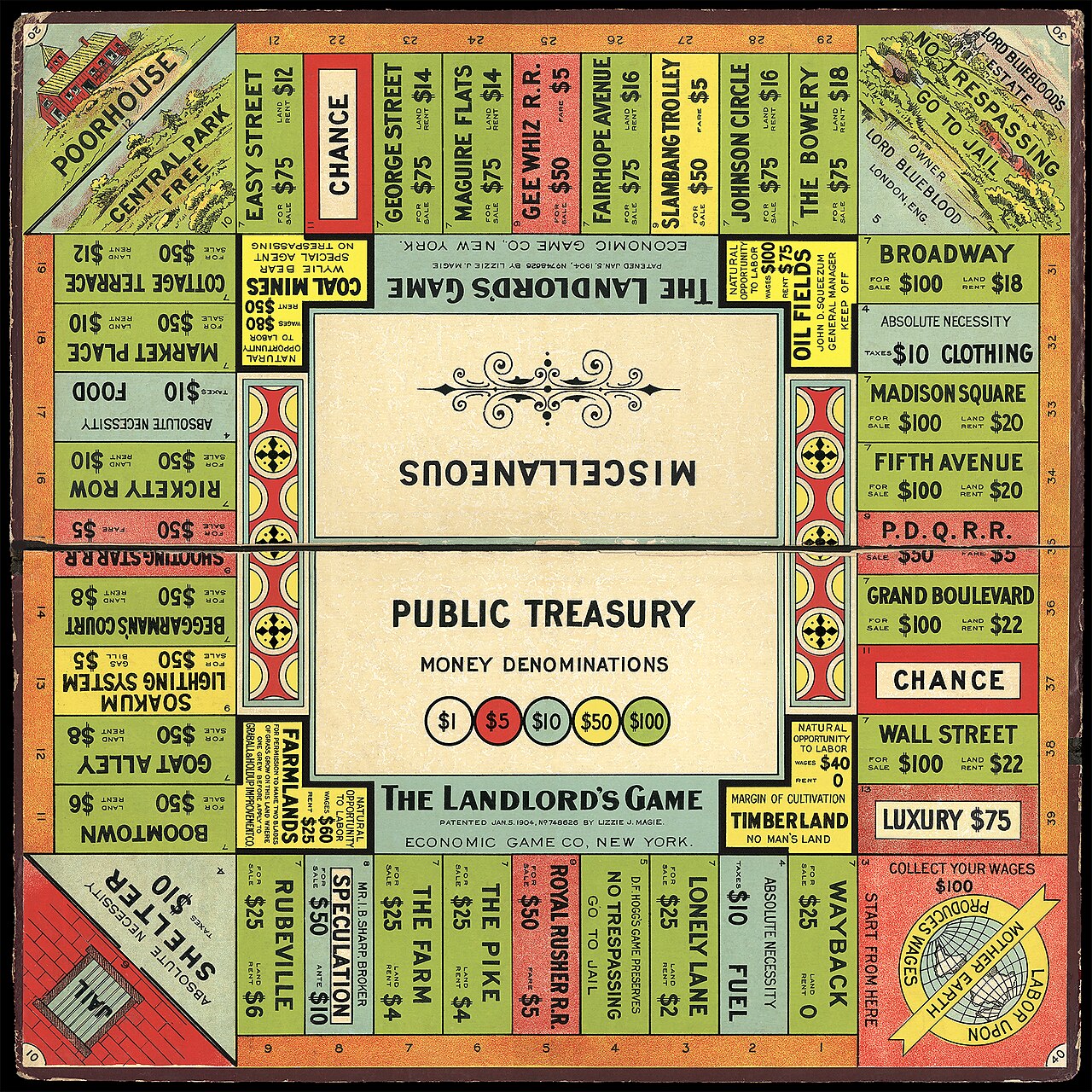
Elizabeth Magie designed *The Landlord's Game* to expose the injustice of land monopolies and demonstrate alternative economic models for wealth distribution. The irony is profound: a game created to teach the perils of unbridled accumulation became the world's most famous celebration of it, erasing its inventor and its original message.
Few diversions so perfectly encapsulate the thrill of ruthless accumulation and the crushing weight of economic dominance as the board game *Monopoly*. For generations, players have relished the moment an opponent lands on their hotel-laden property, forced to concede their dwindling cash or even their entire estate. It is a game synonymous with getting rich by making others poor, a playful enactment of capitalism at its most cutthroat. Yet, this globally recognized celebration of financial conquest began its life with an entirely different purpose: to warn against the very greed it now champions.
The Game of Scarcity
The true origin of *Monopoly* lies not in a desire for lighthearted entertainment, but in a profound social critique. In January 1904, Elizabeth Magie, a staunch advocate of Henry George's economic philosophy, patented *The Landlord's Game*. Magie, a typist, stenographer, and outspoken inventor from Maryland, sought to illustrate the detrimental effects of land monopolies and unfair taxation. George's theories posited that land, being a natural resource, should not be privately owned for profit, and that ground rents should instead fund public services. The escalating cost of rent, he argued, concentrated wealth in the hands of a few and impoverished the many.
Magie’s game was a direct pedagogical tool, designed to make complex economic principles tangible. It featured a circular board with properties, railroads, and utilities, all purchasable by players. Crucially, it shipped with two distinct sets of rules: an "anti-monopolist" set and a "monopolist" set. The anti-monopolist rules, known as the "Prosperity Game," rewarded all players when land values increased, fostering cooperation and demonstrating how a shared economic model could benefit everyone. The monopolist rules, the "Monopoly Game," mirrored the world Magie observed, where players accumulated property to extract rent from others, driving them into bankruptcy. Her intent was for players to experience the stark difference firsthand, to feel the injustice of the monopolist system, and understand the benefits of a more equitable one.
A Lesson Lost in Play
For decades, Magie’s game spread through grassroots communities, progressive thinkers, and university campuses. Players would hand-craft their own boards, adapting property names to local streets and landmarks, and sharing the two rule sets as Magie intended. It was a fluid, evolving creation, a testament to its educational power. However, the aspect of the game that allowed players to crush their opponents proved to be the more compelling, or at least the more commonly adopted, form of play.
The turning point arrived in 1935 when Parker Brothers published *Monopoly*, crediting Charles Darrow as its sole inventor. Darrow, an unemployed heating salesman, had been playing a variant of *The Landlord's Game* popular in his community and brought his version to the company. Parker Brothers acquired Magie's original patent, alongside others, consolidating control over the game. From this moment, the nuanced educational intent of *The Landlord's Game* was excised. The only rules that mattered were those of cutthroat competition and financial ruin for all but one. The company’s marketing narratives focused entirely on Darrow's rags-to-riches story, erasing Magie's pioneering work and critical message.
What Remains
The thread was decisively lost. A game specifically designed to critique the systemic harm of land monopolies and to advocate for a more just distribution of wealth was transformed into its exact opposite. Its inventor, Elizabeth Magie, was written out of history for nearly forty years, her contribution only coming back into public view during the *Anti-Monopoly* trademark litigation of the 1970s. The game that was meant to expose the perils of unchecked accumulation became the ultimate symbol of its triumph, teaching generations not to question the system, but to aspire to dominate it.
Today, *Monopoly* endures as a global phenomenon, its original message almost entirely forgotten by its vast player base. It serves as a powerful, if accidental, example of how a cultural artifact can drift so far from its founding principles that its very name no longer explains its genesis. Perhaps, then, the most radical act for contemporary players would be to seek out the original rules of *The Landlord's Game*, and to play, just once, not to win, but to share.
